If you’re among the legion of Kennedy Expressway commuters who had to put up with gridlock over the past few years during the massive roadwork project and swear you’ve never been in traffic this bad — you’re right.
An analysis of 22 years of drive-time data by WBEZ and the Chicago Sun-Times shows delays on the expressway between downtown and O’Hare Airport were the worst in more than two decades during the Kennedy Expressway rehabilitation project that began in March 2023 and ended last October.
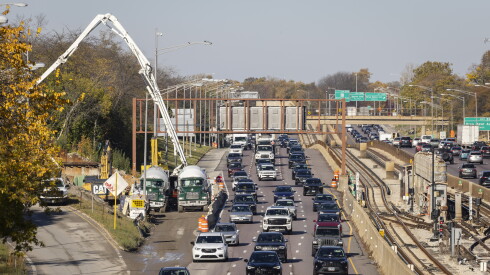
Most of the longest Kennedy commutes on record occurred during the three-year project, as the state of Illinois spent more than $170 million working on the 7.5-mile stretch between downtown and the Edens Expressway junction.
And here's even more bad news for drivers: Despite Gov. JB Pritzker’s promise of "faster commutes" when he declared mission accomplished on the Kennedy project a year ago, the expressway has continued to post many historically bad travel times this year, WBEZ and the Sun-Times found.
That's as the separate Foster Avenue bridge reconstruction project over the Kennedy on the Northwest Side has lagged far behind schedule, with repeated delays, according to documents obtained by WBEZ and the Sun-Times.
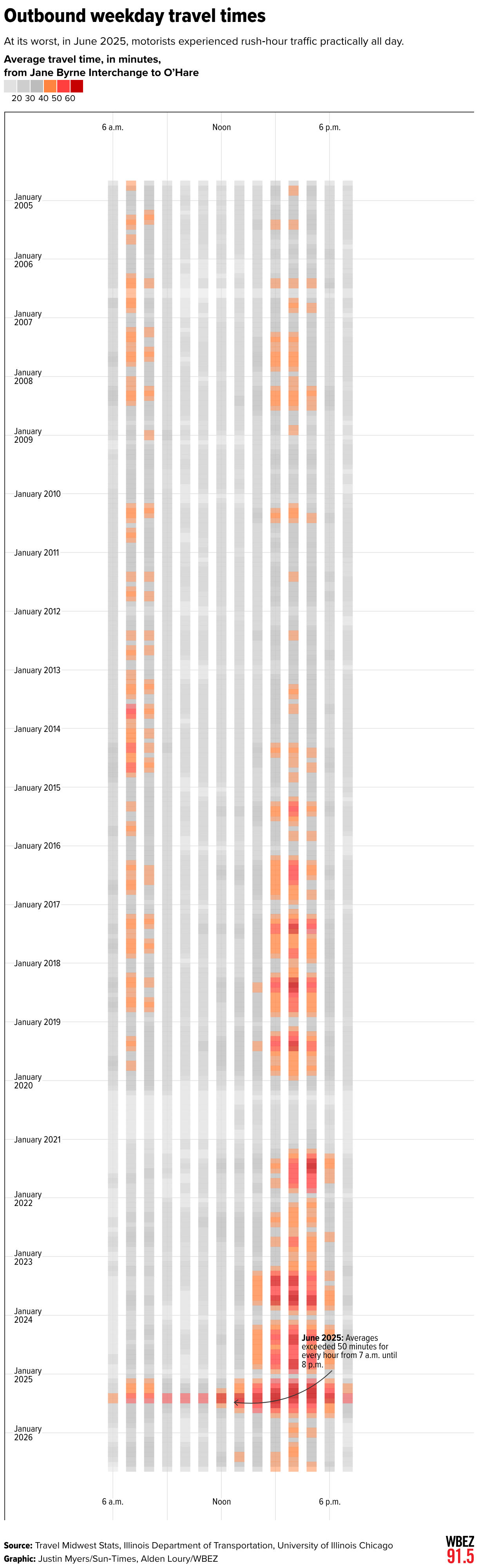
The analysis of traffic data found that June 2025 saw the worst backups ever on the outbound Kennedy, with drivers facing an average commute time of 74 minutes to get from downtown to O’Hare between 2 and 3 p.m. on weekdays during that month. Average outbound travel times exceeded 65 minutes for each hour between noon and 7 p.m. on weekdays that month.
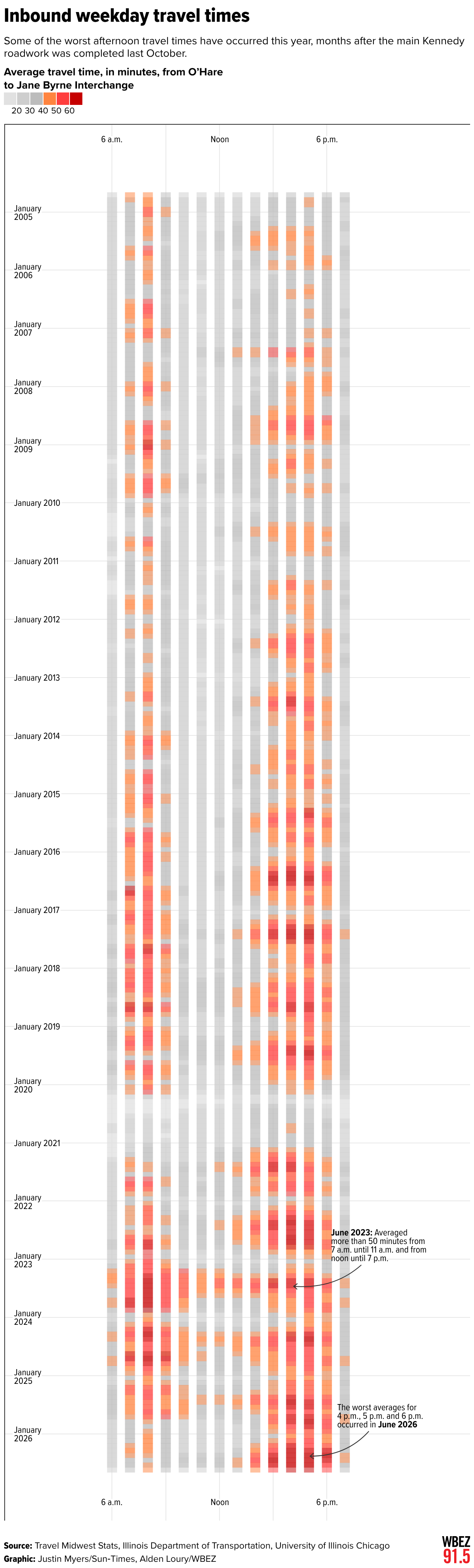
On the inbound Kennedy, headed downtown, the afternoon traffic jams have actually gotten worse since the end of the state project between the Edens junction and downtown.
There was no worse time in the afternoon to get from O’Hare to the Jane Byrne Interchange than between 5 and 6 p.m. on Mondays through Fridays this June — when the average drive time was an agonizing 75 minutes.
Some of the roughly 275,000 commuters who drive the Kennedy each day say the findings of the traffic-data analysis don't surprise them after facing years of crawling along the expressway and sometimes trying to navigate congested local streets in an often vain search for shortcuts.
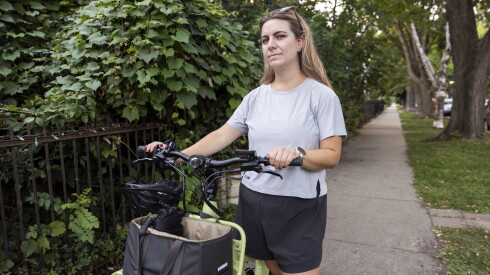
“That was definitely the worst traffic I’ve ever had to deal with,” says Taylor Sticha, 35, who lives in Irving Park on the Northwest Side. “I have lived in Chicago my whole life. I take the Kennedy everywhere I go. And the last few years have been the worst by far.”
She says her commute went from 25 minutes to an hour and 20 minutes almost overnight.
So Sticha bought an e-bike to zip about 11 miles down the lakefront trail from the North Side to her job on the South Side. The commute on the e-bike is longer but faster than driving, taking her about an hour each way.
Sticha is among many commuters who went to extreme measures to deal with or try to avoid the agony of being stuck behind the wheel in barely moving traffic on the Kennedy.
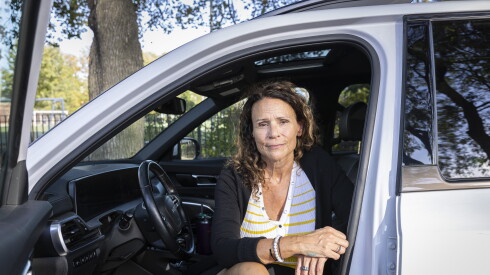
Vivian Haritos, 46, who lives in Albany Park on the Northwest Side, echoes Sticha’s lament.
“I’ve commuted my whole life and traversed the same distance by car my whole life getting to and from school or work, and it’s just never been this bad,” Haritos says. “I’ve never experienced such horrific traffic.”
She says the construction “has negatively impacted my quality of life and even had me questioning my will to live at times.”
The impact of the Kennedy congestion on her psyche became a central and long-running theme of sessions with her therapist, said Haritos, a lifelong Chicagoan who works as a grant writer. By the time she got home after battling traffic, she says she'd be too tired to leave the house and battle traffic again to head out to see friends and family.
“I wasn’t mentally prepared for it,” she says. “It definitely affected my life negatively and affected relationships.”
Haritos says she loves Chicago, but she added, “It shouldn’t be this hard to get to and from work in the greatest city in the world.”
The Kennedy opened to traffic as the Northwest Expressway 66 years ago, a few months before its eventual namesake, John F. Kennedy, took office as president. The Illinois Department of Transportation’s Kennedy Expressway rehab project began in March 2023, marking the first major work on the roadway in almost 30 years.
The project ended a year ago, marking a “major win for Chicago,” IDOT Secretary Gia Biagi said at the time.
The work involved construction on both the inbound and outbound lanes from downtown to the Edens junction, the Kennedy’s reversible express lanes, 24 exit and entrance ramps and dozens of “bridges that hadn’t been touched in decades,” Biagi said at an October 2025 event with Pritzker at which they marked the end of that work.
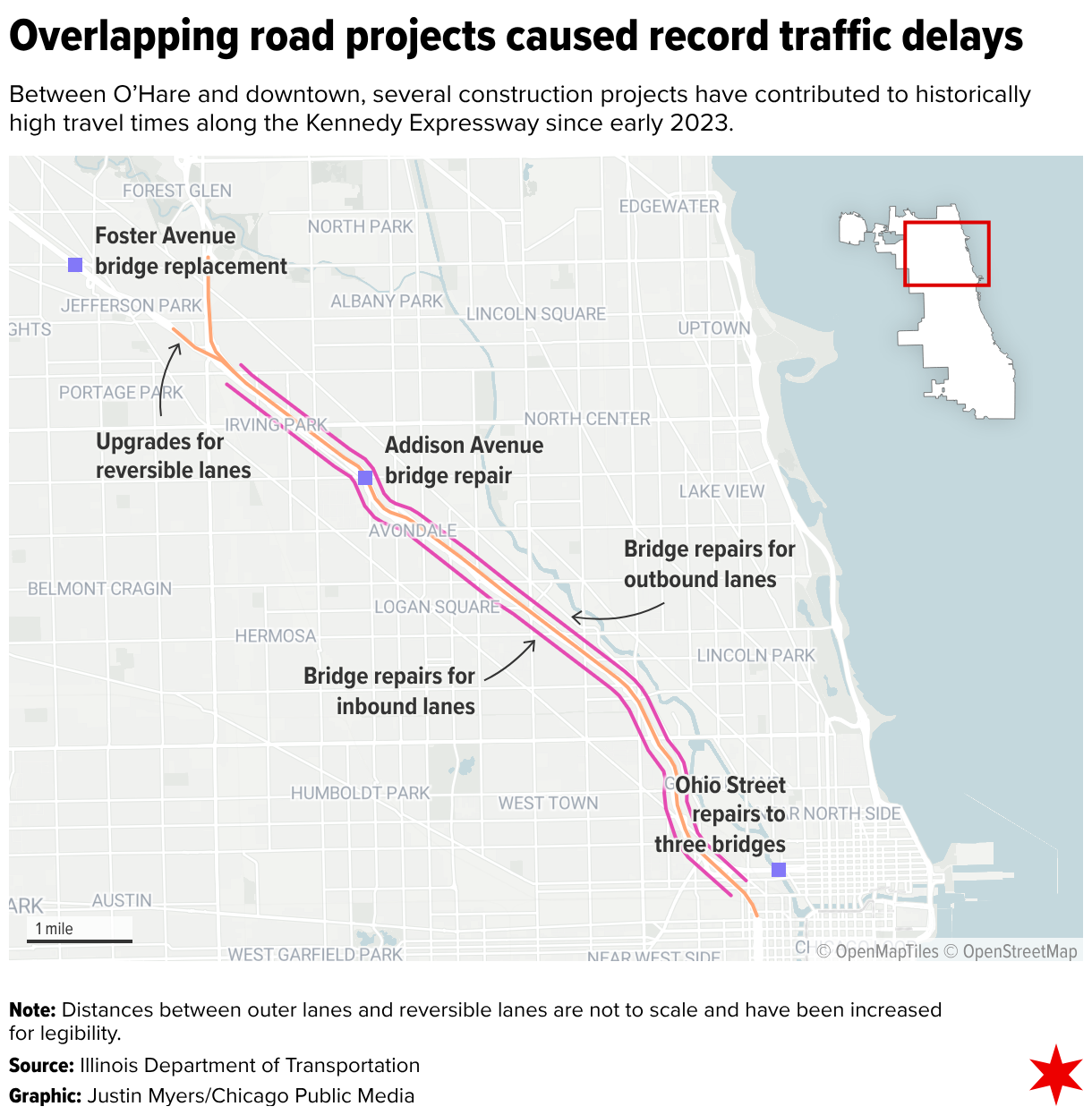
But, though it was the biggest, it was still only one of four significant roadwork projects on the Kennedy, at times overlapping. They cost taxpayers a total of about $225 million, records show.
In addition to the three-year Kennedy project, IDOT also recently finished making improvements to the Addison Street bridge over the Kennedy and to the span that carries traffic to and from the Kennedy on Ontario and Ohio streets over the North Branch of the Chicago River.
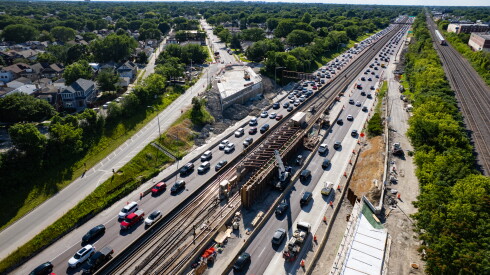
The fourth major project is the ongoing rebuilding of the Foster Avenue bridge. That work began in 2024 but has been plagued by setbacks, according to IDOT documents. Officials say the contractor has not told them when that work will be done.
The worst traffic on the outbound Kennedy was recorded in the summer of 2025 — the only period when work was happening on all four projects related to the expressway at the same time.
In a statement to WBEZ and the Sun-TImes, IDOT officials said all the work was necessary and overdue, but it “did not involve adding lanes or other capacity enhancements.” And they added, “We did anticipate a significant increase in delays as capacity was reduced by approximately 33%.”
Officials also warned that the public increasingly favored driving over public transit during the coronavirus pandemic: “Those behaviors continue to change but likely contribute to longer travel times for the time being.”
WBEZ and the Sun-Times analyzed estimated travel times along the Kennedy dating to October 2004 and continuing through this August. The data come from Travel Midwest Stats, which provides real-time and historical drive-time statistics for roadways primarily in Illinois and Wisconsin.
The analysis covered 3.7 million estimated weekday travel times at five-minute intervals between 6 a.m. and 7:55 p.m. That included inbound and outbound traffic times for the 17 miles between O’Hare and the Jane Byrne Interchange and statistics for how long it took to cover the expressway’s segments from downtown to Montrose Avenue — near the Edens junction – and from Montrose to the airport.
The analysis showed exactly how much the roadwork wreaked havoc with Kennedy commute times. Often, the kind of congestion you normally would expect only during rush hour was seen from early in the morning right on through evening.
In the nearly two decades prior to the start of the Kennedy rehab project, 4 p.m. was the peak hour for outbound traffic on weekday afternoons, averaging roughly 39 minutes. And 8 a.m. was historically the peak hour for inbound traffic on weekday mornings, averaging about 46 minutes.
Compare that to the traffic times on the Kennedy in June 2025, when outbound drivers faced an average drive of more than 50 minutes for every hour from 7 a.m. until 8 p.m. on weekdays. In effect, drivers faced a rush hour that lasted all day long.
Inbound traffic also experienced long stretches of rush-hour congestion. In June 2023, hourly traffic heading toward downtown on the Kennedy averaged more than 50 minutes from 7 a.m. until 11 a.m. and from noon until 7 p.m.
“This data is eye-opening,” says Joseph Schwieterman, a transportation professor who is the director of the Chaddick Institute for Metropolitan Development at DePaul University. “We see that motorists have lived through multiple years of congestion. And it’s not just rush hour. It’s all times of day.”
Schwieterman says the Kennedy’s chronic traffic backups and the lack of a quicker rail link between O’Hare and downtown hurts Chicago drivers and also damages the city's reputation with visitors.
“You look at, by some measures, the country’s busiest airport at O’Hare, and a big, successful, global downtown, and you really have a tough time getting between the two,” Schwieterman says. “We have an expressway that’s, by national standards, among the most congested.”
The Kennedy is the single biggest factor making Chicago’s freeway traffic the worst in the country — and among the worst in the world, one recent study found.
The typical driver in Chicago lost 112 hours to traffic in 2025, with a personal cost of $2,063 and a citywide loss of $7.5 billion, according to INRIX, a transportation analytics company based in Bellevue, Wash. Chicago ranked dead last in the country and second-worst in the world, with only drivers in Istanbul, Turkey, spending more time in traffic jams than Chicago’s motorists.
INRIX also identified the 10 most-congested sections of road in the United States in 2024, and five of them were in Chicago — including two segments of the inbound Kennedy and one portion of the outbound Kennedy.
At the news conference last year, when the main Kennedy reconstruction project ended, the governor, Biagi and other state officials and labor leaders took turns heralding what they promised was a new and less-congested era for commuters.
“At a time of historic division in our politics, there is one idea we can all rally around, and that’s ‘traffic sucks,’” Pritzker said, laughing. But he added, “We’ll have faster commutes in the long run as a result of this.”
That’s not yet the case on the stretch of the Kennedy that slices through the Northwest Side toward O'Hare.
“It’s weird to pretend it’s done when it very clearly isn’t,” says Sebastian de la Torre, 25, a mechanical engineer who reverse-commutes each day between his job in Elk Grove Village and his apartment in the North Center neighborhood. “There’s hundreds of thousands of people that drive through there every day. Everyone sees that it’s not done.”
The data analyzed by WBEZ and the Sun-Times backs him up. The inbound Kennedy actually got more congested after Pritzker’s news conference on Oct. 24, 2025. In June, the inbound Kennedy recorded its worst hourly averages in the 22-year period of the analysis for the 4 p.m. (72 minutes), 5 p.m. (75 minutes) and 6 p.m. (63 minutes) hours on weekdays.
And much of the most severe congestion for the portion of the Kennedy between O’Hare and Montrose has come this year. At some hours, in April, May and June this year, it would take you an average of more than 35 minutes just to get from the airport to Montrose — which still leaves you about eight miles from the Byrne Interchange.
The particularly bad traffic on the Northwest Side includes the area near the Foster Avenue bridge, which has been under construction for two years.
De la Torre moved to his apartment on the North Side in early 2025, after work began to tear down the bridge across Foster and build a new one.
“I never lived in a world where that bridge was up,” de la Torre says. “So I guess I’m excited to see what my commute is whenever they finish that bridge.”
De la Torre says he has tried to research when that day might finally come, but he’s been frustrated by a lack of answers from IDOT.
“It’s their job to be transparent to the public they serve allegedly,” he says. “I think it would help everyone to not be super-frustrated with the state of things in the state.”
IDOT initially rejected public records requests from WBEZ and the Sun-Times for meeting minutes and other documents pertaining to the four Kennedy-related roadwork projects, including the Foster Avenue bridge reconstruction, saying it would be too much work for them to gather and release those documents.
The news organizations, represented by attorneys Matt Topic and Josh Loevy, sued IDOT last year in Cook County court, citing violations of the state’s Freedom of Information Act. The agency relented recently and produced the disputed records and other documents related to the projects.
Those records shed light on what’s really been happening with the Foster bridge project. They show it was plagued almost from the start by problems and delays.
The main contractor for the project, IHC Construction Companies of Elgin, submitted a “time-extension request” in July 2025, though state officials did not publicly announce those delays until this spring. Officials allowed the deadline to be pushed back from the end of May to Oct. 9 — but the work has continued.
In internal project correspondences, IHC executives said several problems have caused delays at the Foster site, but they said the biggest factor was slower-than-expected cooperation from the Chicago Transit Authority, whose Blue Line train tracks run down the center of the expressway at Foster.
Despite publicly pushing the completion date to the end of the year, officials still cannot say exactly when the project will be done, records show. The contractor has told officials that a second formal request will be filed for yet more time, citing weather-related issues and other delays, but has not yet provided officials with a new deadline.
“We have requested the revised baseline schedule from the contractor multiple times at the recent progress meeting, but we have not received it yet,” an engineer on the project wrote to state officials on Sept. 28, after IDOT told him a WBEZ reporter had filed a public records request for those documents.
Asked this week when the company’s work would be done, the project manager for IHC declined to comment, saying, “Since we are under contract with IDOT, these questions should go through them.”
IDOT officials now say they still expect the new Foster bridge to be open by the end of this year, although they added that electrical, sewer and landscaping work could continue there until the spring of 2027.
“This project is in a tight, urban environment and requires close coordination with the CTA and nearby railroad,” IDOT said. “We try our utmost to avoid them, but it’s not unusual for large, complex projects to have unforeseen issues develop throughout the course of the contract.”
Officials say they inform the public about delays “once there’s agreement on a revised timetable” with contractors.
State transportation officials also sought to brush aside concerns about the continued congestion near the Foster Avenue work site and beyond.
“Without looking at your data, we are confident based on our own observations and general feedback, that traffic overall on the expressway has improved since the project concluded as compared to when construction was taking place,” IDOT said in its statement to WBEZ and the Sun-Times.
“There could have been impacts from short-term disruptions over the summer, such as staging for the Foster Avenue project. We also have seen a busy festival season along with major events in the city temporarily inflate travel times over a short period of time compared to longer-term trends.”
But the long-running work at the bridge site has created gridlock not only on the Kennedy but also on streets in the quiet residential neighborhoods near the Foster construction. Drivers seeking to avoid the traffic have greatly increased the number of vehicles zooming down narrow side streets.
One homeowner in Jefferson Park even sent his City Council member’s office a door-camera video of a CTA bus taking a shortcut down a residential stretch of Mango Street.
“All the streets surrounding the Foster Bridge are also snarled, making it a terrible place to live and travel through right now,” one woman wrote to the office of Ald. James Gardiner (45th).
Records obtained by WBEZ show his office relayed concerns to IDOT, and a state official told a Gardiner aide in April that “unforeseen problems outside the control of the contractor” have led to additional delays.
The original budget to replace the Foster bridge was $25.2 million. But the estimated final cost now exceeds $28.6 million, records show.
Compared to how things were before the Kennedy rehabilitation began, average inbound travel times from O’Hare to downtown were nearly eight minutes longer at 8 a.m. on weekdays since the Kennedy work began.
Then, driving outbound at 5 p.m., you would have spent an average of more than 11½ minutes longer than before the roadwork began to get from downtown to the airport.
At that rate, someone who commutes to and from a job downtown from near the airport or beyond each day at those times has spent more than 17,000 additional minutes on the Kennedy between the start of the construction work in 2023 through August.
That works out to about 290 extra hours on the road — 12 full days stuck in worse-than-normal traffic.
Some commuters say they have struggled to cope with the situation.
Kristin Hoogenboom, who has to be at her job at a TV station downtown by 6 a.m., would wake up at 1:30 a.m. at her home in Elgin, get in a workout, drive to her husband’s office near downtown and take a nap there before starting her shift. That was better than waiting through construction delays, she says.
“That way, I didn’t have the stress of, ‘Oh, my gosh, am I gonna make it on time?’” says Hoogenboom, 53. “I did that for three years because I just didn’t want to deal with the IDOT Kennedy reconstruction project in the morning.”
She says taking a Metra train wasn't an option because walking alone across downtown in the predawn darkness was too dangerous. But she couldn't avoid the traffic on the way home, and it still takes her about 90 minutes to get to Elgin after work in the mid-afternoon.
“I changed my whole lifestyle because of IDOT for those three years,” Hoogenboom says.
Sticha, the woman who resorted to taking an e-bike to work, tried other ways to manage the construction-induced traffic before ultimately ditching her car for a new mode of transportation. She would bring a change of clothes and gym shoes and stop her commute home halfway to take a stroll on the 606 trail.
“Do a walk for 30, 40 minutes, get back in the car and then finish the commute,” she says. “Just try to cool myself down and get a little physical activity in.”
Public transit between her work and job were not convenient, and it was a bit far for her to bike each way. She turned to the e-bike and found a circuitous route that cut her commute each way to one hour.
To get to work in Pilsen, which is a 10-mile drive from home, she instead took a longer, 15-mile route on the e-bike, heading east to Lake Michigan, then down the bicycle path along the lakefront before cutting west over the 18th Street Pedestrian Bridge.
“If anything positive came out of this, it was getting that e-bike because now it’s one of my prized possessions,” Sticha said.
Using pain to stay awake at the wheel
The excessive traffic had an emergency-room nurse from the University of Chicago Medical Center worrying that she might fall asleep driving home to the North Side from her overnight shifts at the hospital in Hyde Park along the South Side’s lakefront.
“My normally 45-minute commute home turned into an hour-and-a-half commute home, and it was just too long for me to be able to withstand the powerful wave of sleep that would come over me,” Emma Squier says of her drive home in the early morning.
She tried blasting loud music.
“But that was just not effective,” she says. “So I would start doing these things to inflict pain on myself because that was really the only thing that would keep me awake. I would drive with one hand and bite the other hand while I was driving, or I would slap myself in the face.”
Squier says some coworkers from the night shift told her they would “roll their hair up in the window of the car, so their hair is constantly being pulled,” with the jolt of pain preventing them from dozing off.
In the ER at the UChicago hospital, Squier has seen what can happen to those who fall asleep while driving.
“Every day when I would get off work and get in my car to go home, I would be, like, OK, well, I really hope I don’t die, and I really hope I don’t kill somebody today,” she says.
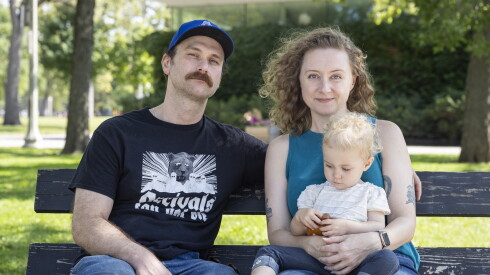
Another woman from the Northwest Side went into labor — and had to get from her home in Portage Park to Northwestern University's Prentice Women’s Hospital downtown — just as a major traffic jam was building on the Kennedy early on a weekday morning in September 2024.
“We start driving, and we get onto the highway at Irving Park Road, and we just immediately get stuck in traffic,” says Anna Behm, a librarian who’s now 41. “Just wall-to-wall cars, and we are kind of stuck on the highway.”
Behm’s husband kept going on the Kennedy because no other route was better, according to the GPS. It ended up taking them more than two hours to get to Prentice, Behm says.
The data analyzed by WBEZ and the Sun-Times shows how much worse the traffic got even as Behm and her husband tried to get to the hospital. At 6:30 a.m. that day, the inbound trip from the airport to downtown was about 50 minutes. But that quickly ballooned to 97 minutes by 8:35 a.m..
Behm says she was suffering in the passenger seat, thinking, “This just feels inhumane to me. I feel like I’m being tortured right now. That’s how intense the pain was.”
She says she wasn't too mad at the state officials overseeing the construction project in the end because she made it to the hospital in time to give birth to a “beautiful, healthy baby girl.” She and her husband named the girl Cricket. They call her Kit.
Even so, it wasn't an experience Behm would ever want to go through again.
“It’s not like it took us two hours to get there because there was a blizzard,” she says. “It’s not like it was something that was an act of God.
“There really has to be a better way to move people around the city and do infrastructure work. That needs to happen without completely shutting down the main artery into Chicago.”
Dan Mihalopoulos is an investigative reporter for WBEZ. Alden Loury is data projects editor.
Contributing: Justin Myers